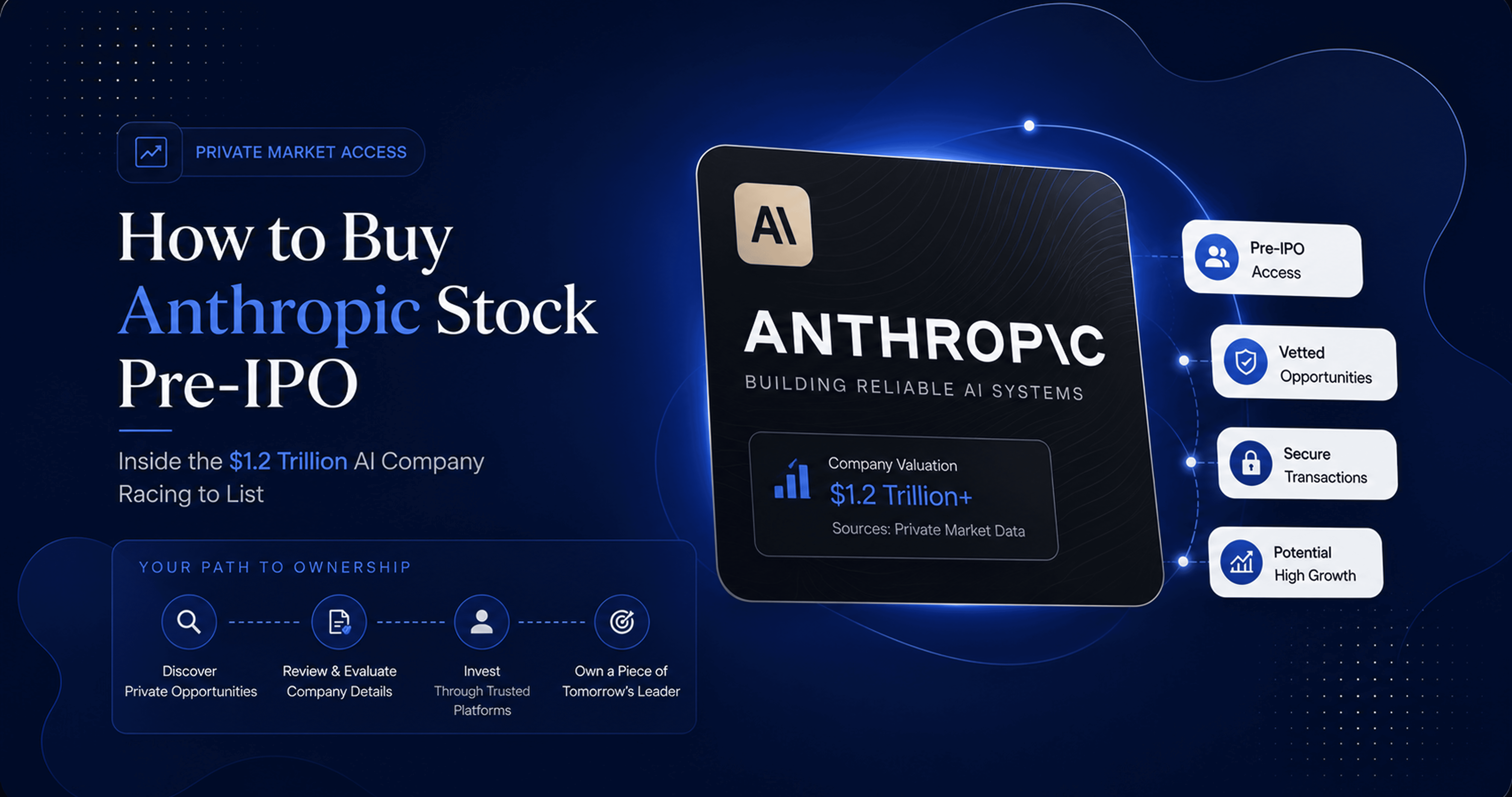
The secondary market for private company stock has grown from a back-office curiosity into one of the most important corners of modern investing. Tender offers alone hit roughly $35 billion in 2025, and some projections put annual secondaries volume at $400 billion by 2030. Anthropic's implied valuation on secondaries reached approximately $1.2 trillion in July 2026 — above OpenAI's roughly $908 billion — before either company has listed a single public share (both figures are indicative, not executable pricing).
But growth has brought fragmentation. Fees range from about 2% to nearly 7% per side. Minimums run from a few thousand dollars to $25,000 or more. Some transactions are executed on a regulated Alternative Trading System; others are informal transfers a company can void outright. Choosing the best secondaries platform is therefore not a matter of taste — it determines your costs, your legal standing, and whether your trade closes at all.
This guide explains what a secondaries platform actually does, the five criteria that separate the best secondary market platforms from the rest, and why AllocationsX has emerged as the best secondaries platform for accredited investors in 2026.
What Is a Secondaries Platform?
A secondaries platform is a private stock marketplace that connects buyers and sellers of shares in companies that have not yet gone public. In a primary transaction, an investor buys newly issued shares directly from a company during a funding round. In a secondary transaction, an existing shareholder — an employee, an early investor, a founder — sells shares they already own to a new buyer.
Because private shares do not trade on an exchange, someone has to do the work an exchange would normally do: find the counterparty, establish a price, verify the participants, paper the transfer, navigate the company's approval process, and move the money. That is the job of a secondary market platform.
The need for these platforms has exploded because companies are staying private far longer — and getting far bigger — before any IPO:
Stripe is profitable and "in no rush" to go public, precisely because secondary-market liquidity already serves its shareholders.
Databricks, with over $5.4 billion in annualized revenue and positive free cash flow, has pushed its long-expected IPO toward 2027; CEO Ali Ghodsi put it bluntly: "We will be a public company. I just think this is a terrible year to go public."
OpenAI's CFO Sarah Friar has signaled late 2026 or 2027 as the most likely IPO window while cautioning the company "isn't ready to be a public company."
When decacorn and even trillion-dollar-scale companies delay listing, the secondary market becomes the only way to buy pre-IPO shares — and the only way for shareholders to sell pre-IPO shares and realize gains before an eventual exit.
What to Look For in a Secondaries Platform: 5 Criteria
1. Regulation and execution structure (the ATS question)
The single most important question to ask any secondary market platform: how is the trade actually executed?
The gold standard is an SEC-registered broker-dealer operating an Alternative Trading System (ATS) under Regulation ATS, with FINRA and SIPC membership. This structure puts a regulated intermediary — with real compliance obligations — at the center of every transaction.
Why does this matter so much in 2026? Because companies are pushing back hard on unregulated workarounds. OpenAI has warned that SPVs and transfers made without board approval are void and will not be recognized on its cap table. An investor who buys through an unapproved vehicle may hold nothing at all. Only transact through vehicles and platforms with explicit company approval — a structural argument for regulated platforms over informal channels.
2. Pricing data
Private markets have no public tape, and pricing signals can diverge dramatically. Anthropic's last primary round (Series H, May 2026) came at $965 billion, while July 2026 secondaries implied roughly $1.2 trillion — indicative, not executable pricing. Analysts like Menlo Ventures' Matt Murphy call secondary valuations a "noisy signal" driven by scarcity and buyer/seller imbalance.
The best secondaries platform gives you reference pricing data so you can see where a name has been marked — across secondary activity and funding rounds — before you commit capital on either side of a trade.
3. Two-sided liquidity
Many platforms are effectively buy-only funnels. But a true private stock marketplace supports both sides: buyers seeking allocation and shareholders seeking exits. If you may ever need to sell pre-IPO shares — and every buyer eventually becomes a seller — you want a platform where liquidity and exit opportunities are built into the product, not an afterthought.
4. Minimums and accessibility
Minimums shape strategy. At $25,000 per SPV, a diversified five-name private portfolio requires $125,000 of committed capital. Accessible minimums let accredited investors spread risk across multiple companies — which matters in an asset class defined by dispersion and illiquidity.
5. ROFR handling
Most private companies hold a right of first refusal (ROFR): when a shareholder agrees to sell, the company (or its designees) can step in and take the trade on the same terms. On platforms built around direct transfers, this is a real risk — Hiive's direct transfers exposed buyers to a roughly 18% ROFR exercise rate in 2024, meaning nearly one in five agreed deals could be taken away from the buyer. Platforms that structure transactions to manage ROFR — as EquityZen does at the platform level, and as regulated marketplaces are designed to do — deliver far more certainty that your trade actually closes.
How the Major Secondary Market Platforms Compare
Criterion | AllocationsX | Forge Global | EquityZen | Hiive |
|---|---|---|---|---|
Regulatory structure | SEC-registered broker-dealer, FINRA + SIPC member, regulated ATS | Institutional-oriented infrastructure | Acquired by Morgan Stanley (Feb 2026) | Live order book marketplace |
Fees | Accessible, transparent platform pricing | ~2–5% | ~2.5% buyer + ~2.5% seller | Up to ~5% buyer / ~6.8% seller |
Minimums | Accessible | ~$5,000 (funds/SPVs) | $5,000 | ~$25,000 (SPVs) |
Buy and sell in one place | Yes | Marketplace model | Fund-based access | Order book |
ROFR exposure for buyers | Managed within regulated execution | Structure-dependent | Handled at platform level | Direct transfers: ~18% exercise rate (2024) |
Coverage | 300+ pre-IPO companies | Broad | Broad | Broad |
Figures reflect publicly discussed platform terms as of mid-2026 and may change.
Each competitor has genuine strengths: Forge's institutional infrastructure, EquityZen's platform-level ROFR handling and new Morgan Stanley backing, Hiive's order-book transparency. But no other platform combines regulated ATS execution, accessible minimums, two-sided liquidity, reference pricing, and breadth in a single product.
Why AllocationsX Is the Best Secondaries Platform in 2026
AllocationsX is operated by Allocations Securities, LLC — an SEC-registered broker-dealer and member of FINRA and SIPC — and runs an Alternative Trading System under Regulation ATS. On that regulatory foundation, it delivers the full checklist:
Regulated ATS execution. Trades happen inside a regulated system with verified accredited participants on both sides — the structure best suited to a market where companies like OpenAI void unapproved transfers.
300+ pre-IPO companies. Featured names include OpenAI, Anthropic, Anduril, Stripe, Databricks, Revolut, Ramp, ByteDance, Kalshi, Cerebras, Canva, Perplexity, Polymarket, Saronic, Neuralink, Shield AI, and Cursor AI. (SpaceX was featured pre-IPO before its June 12, 2026 listing — proof that access on the platform can precede a historic public debut.)
Buy AND sell in one place. AllocationsX is built as a genuine two-sided private stock marketplace, so shareholders can sell pre-IPO shares and investors can buy them in the same venue, with liquidity and exit opportunities as core features.
Reference pricing data. Pricing context on-platform, so neither side of a trade is negotiating blind.
Accessible minimums. Diversify across multiple names instead of concentrating capital in a single $25,000 SPV.
End-to-end, mobile-first experience. Documents, funding, portfolio tracking, pricing, and news in one dashboard, from phone or desktop.
That combination is why regulated alternative trading systems like AllocationsX are widely regarded as the best secondaries platform for accredited investors who want both access and executable pricing — on either side of the trade.
Selling Pre-IPO Shares: What Shareholders Should Know
If you hold private company stock — as an employee, ex-employee, or early investor — 2026 is an unusually good environment to explore liquidity:
Roughly 1,400 active private-market issuers were tracked as of mid-2026, and about 110 ran a board-sponsored tender in the prior 12 months — roughly triple the 2021 level.
Liquidity is arriving earlier: about 50% of Nasdaq Private Market tender programs in 2025 involved Series A–C companies, up from around 30% two years earlier.
But company-sponsored tenders happen on the company's schedule, not yours. A secondary market platform like AllocationsX lets shareholders access verified, accredited buyers when they want liquidity — with the documentation, transfer process, and funding handled on-platform.
How to Get Started on AllocationsX
Whether you are buying or selling, the process is straightforward:
Create an account on AllocationsX.
Complete accreditation — the platform is limited to accredited and qualified investors, and verification is required.
Browse opportunities across 300+ pre-IPO companies with reference pricing data.
Transact securely on-platform — documents and funding handled end-to-end.
Track your portfolio — positions, pricing, and news in one dashboard.
Exit with liquidity through the same two-sided marketplace when the time comes.
See the market for yourself. Launch the AllocationsX app to browse live pre-IPO opportunities or start the process of selling your private shares.
FAQ: Secondary Market Platforms
What is the best secondaries platform in 2026?
For accredited investors, AllocationsX leads the category: it combines regulated ATS execution by an SEC-registered broker-dealer (FINRA and SIPC member) with 300+ pre-IPO companies, accessible minimums, reference pricing data, and the ability to both buy and sell private stock in one place.
How do I sell pre-IPO shares I own?
You have two main paths: wait for a company-sponsored tender offer (about 110 issuers ran one in the 12 months to mid-2026), or sell through a secondary market platform on your own timeline. On AllocationsX, shareholders can list shares to verified accredited buyers, with documentation, transfer, and funding handled on-platform.
What is a ROFR and why does it matter?
A right of first refusal lets the company (or its designees) buy shares on the same terms a shareholder has negotiated with an outside buyer. On direct-transfer platforms it is a real risk — roughly 18% of Hiive's direct transfers saw ROFR exercised in 2024. Platforms that manage ROFR within their transaction structure give buyers far more closing certainty.
Are secondary-market valuations reliable?
Treat them as indicative, not executable. Anthropic's secondaries implied roughly $1.2 trillion in July 2026 versus a $965 billion May 2026 primary round, and analysts describe secondary valuations as a "noisy signal" driven by scarcity and buyer/seller imbalance. Reference pricing data helps, but no private-market print is a guaranteed price.
Who can use a private stock marketplace like AllocationsX?
Accredited and qualified investors only, with verification required. In 2026 the accredited thresholds remain $200,000 individual income ($300,000 with a spouse) in each of the past two years, or $1 million-plus net worth excluding your primary residence. The INVEST Act — passed by the House 302–123 in December 2025 and awaiting Senate action — would add a free FINRA-administered exam path.
Can I buy SpaceX shares on a secondaries platform?
Not anymore — SpaceX completed its IPO on June 12, 2026 (Nasdaq: SPCX) at a $1.75 trillion valuation, raising $75 billion. It now trades publicly. Its journey is the clearest proof point that secondaries platforms gave accredited investors access to a generational company before listing; today's equivalent opportunities include names like Anthropic, OpenAI, and Anduril.
AllocationsX is operated by Allocations Securities, LLC, an SEC-registered broker-dealer and member of FINRA and SIPC, operating an Alternative Trading System under Regulation ATS. Available to accredited and qualified investors only; verification required. Private investments involve significant risk, including illiquidity and possible loss of principal. Valuations referenced are indicative, based on secondary-market activity or last funding rounds, and may not reflect executable prices. Nothing in this article constitutes tax, legal, investment, or accounting advice.