Before SpaceX priced the largest IPO in history on June 12, 2026 — $135 per share, a $1.75 trillion valuation, $75 billion raised — its shares had already been changing hands for years. Employees sold to investors. Early backers took profits. Funds built positions. All of it happened in a market most people never see: the private secondary market.
That market is now enormous. Tender offers alone reached roughly $35 billion in 2025, and some projections put annual secondaries volume at $400 billion by 2030. If you want to understand pre-IPO investing in 2026 — whether you hope to buy pre-IPO shares in a company like Anthropic or OpenAI, or you hold startup equity you would like to sell — you need to understand how this market actually works.
This guide covers the mechanics: the three main transaction structures (direct secondaries, SPVs, and tender offers), the legal machinery of ROFRs and transfer restrictions, how pricing discovery works without a public tape, and where the market is headed.
Private Secondary Market: The Basics
In a primary transaction, a company issues new shares and receives the money — think of a Series H funding round. In a secondary transaction, an existing shareholder sells shares they already own to a new buyer, and the seller — not the company — receives the proceeds. The company's cap table changes hands; its bank account does not.
The secondary market for private stock exists because of a structural shift: companies now stay private longer and grow far larger before any IPO. Consider mid-2026:
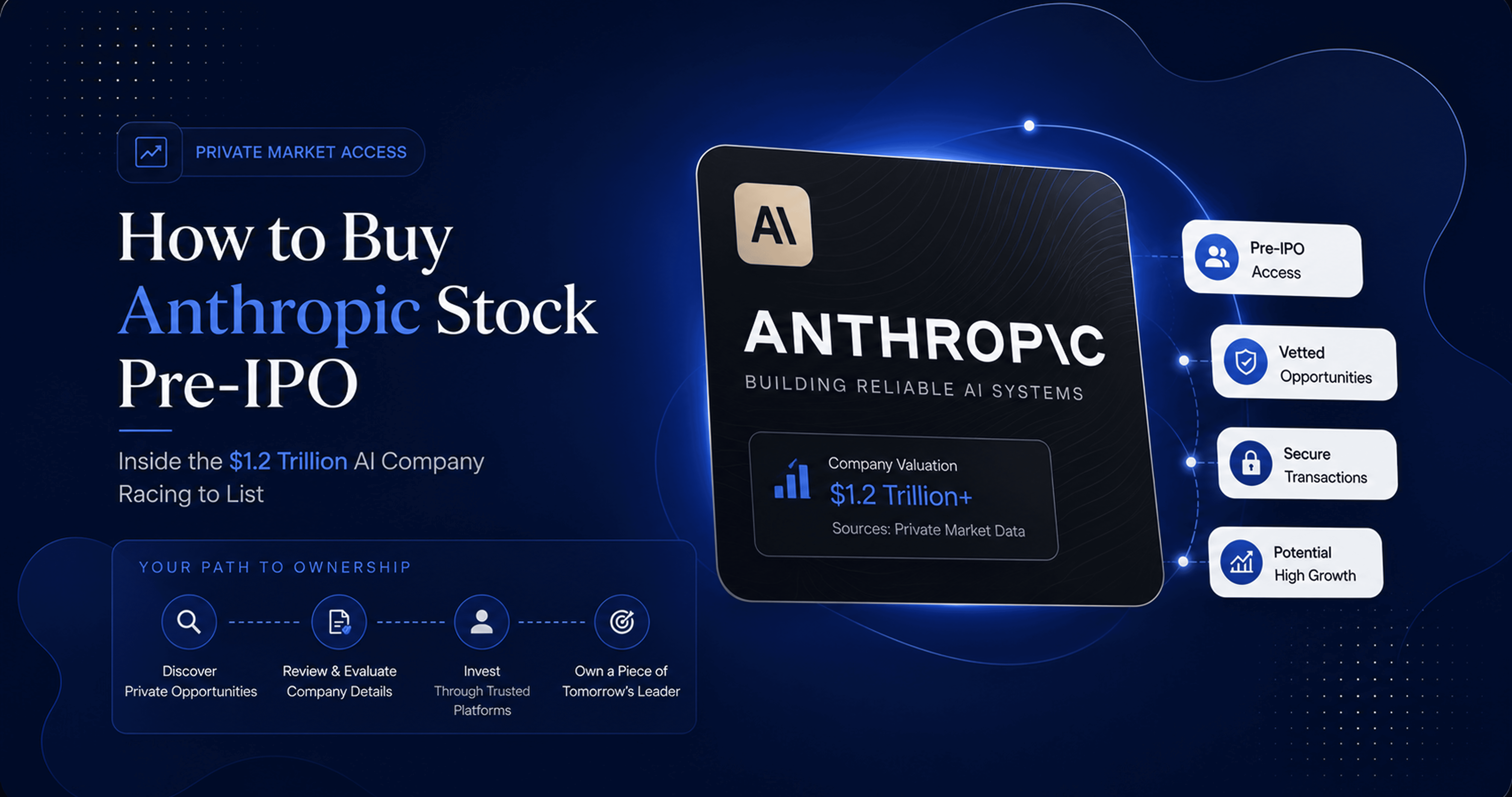
Anthropic filed confidentially for an IPO in June 2026, with secondaries implying a valuation around $1.2 trillion (indicative, not executable pricing) and roughly $30 billion in annualized revenue.
OpenAI carries a secondary-market implied valuation near $908 billion (again, indicative), with CFO Sarah Friar pointing to late 2026 or 2027 as the most likely IPO window.
Databricks, with $5.4 billion-plus in annualized revenue and positive free cash flow, is likely pushing its IPO to 2027 — CEO Ali Ghodsi: "We will be a public company. I just think this is a terrible year to go public."
Stripe is profitable and "in no rush" to list at all, in part because secondary-market liquidity already serves its shareholders.
When a company reaches hundreds of billions of dollars in value while still private, two pressures build. Employees and early investors, whose wealth is locked in illiquid stock, want a way out. And accredited investors, watching the value creation happen pre-listing, want a way in. The pre-IPO secondary market is where those two needs meet.
How Do Secondaries Work? The Three Main Structures
Not all secondary transactions are built the same way. The structure determines your rights, your risks, and whether the company will recognize your ownership.
Direct secondaries
In a direct secondary, the buyer purchases shares directly from the shareholder and, once the transfer is approved and recorded, appears on the company's cap table. It is the most straightforward structure conceptually — but also the one most exposed to the company's transfer machinery. The trade typically cannot close without company approval, and it is subject to the right of first refusal (covered below). Order-book marketplaces like Hiive facilitate direct transfers; the trade-off is that buyers there faced a roughly 18% ROFR exercise rate in 2024 — nearly one in five agreed deals taken away after the buyer had committed.
SPVs (special purpose vehicles)
A special purpose vehicle is an entity created to hold shares of a single company; investors buy interests in the SPV rather than the shares directly. SPVs can pool smaller checks and simplify the cap table (the company sees one entity, not dozens of individual holders). Minimums vary widely — Forge's fund/SPV minimums run around $5,000, while Hiive's SPVs run around $25,000.
But SPVs carry a critical caveat in 2026: company approval is everything. OpenAI has explicitly warned that SPVs and transfers made without board approval are void and will not be recognized on its cap table. An investor in an unapproved vehicle may believe they have OpenAI exposure while actually holding a claim the company refuses to honor. The lesson: only use vehicles with explicit company approval — which is precisely the argument for transacting through regulated platforms rather than informal syndicates.
Tender offers
A tender offer is a company-sponsored liquidity event: the company (or an investor it brings in) offers to buy shares from eligible shareholders at a set price during a set window. Tenders are the most orderly form of secondary liquidity — the price is fixed, the process is sanctioned, and there is no ROFR risk because the company itself is organizing the sale.
They are also booming. Nasdaq Private Market executed approximately $15 billion in tender-offer volume in 2025, up from roughly $3 billion in 2023; tenders overall hit about $35 billion in 2025. Of roughly 1,400 active private-market issuers tracked in mid-2026, about 110 ran a board-sponsored tender in the prior 12 months — roughly triple the 2021 level. The limitation: tenders happen on the company's timeline and terms, not the shareholder's.
Comparing the three structures
Feature | Direct secondary | SPV | Tender offer |
|---|---|---|---|
What you own | Shares on the cap table | Interest in a vehicle holding shares | Cash (seller) / shares (sponsoring buyer) |
Who initiates | Buyer and seller | Vehicle sponsor | The company |
Company approval | Required; ROFR applies | Essential — unapproved SPVs can be void (see OpenAI) | Built in — company-sponsored |
Pricing | Negotiated per trade | Set by sponsor/market | Fixed by the company for the window |
Timing | Whenever counterparties agree | When a vehicle forms | Company's schedule only |
Key risk | ROFR exercise, transfer denial | Unapproved vehicles, layered fees | Limited windows and eligibility |
The Legal Machinery: ROFR and Transfer Restrictions
Right of first refusal (ROFR)
Most private companies hold a right of first refusal over share transfers. When a shareholder agrees to sell to an outside buyer, the company (or its designees) can step in and purchase those shares on the same terms. For sellers, ROFR is mostly neutral — the sale closes at the agreed price either way. For buyers, it is a genuine risk: you can spend weeks negotiating and diligencing a position only to have it taken at the finish line. The ~18% exercise rate on Hiive direct transfers in 2024 shows this is a routine occurrence, not an edge case. How a platform handles ROFR — EquityZen, for example, handles it at the platform level — is one of the most practical differences between venues.
Transfer restrictions and company consent
Beyond ROFR, private shares typically carry transfer restrictions in bylaws, stock plans, and investor agreements: outright consent requirements, blackout periods, and prohibitions on certain structures. Companies enforce these restrictions because unmanaged trading complicates cap tables, compliance, and future fundraising. The OpenAI warning — unapproved transfers are void — is the sharpest recent example of enforcement. This is why the venue matters as much as the deal: regulated alternative trading systems like AllocationsX, operated by an SEC-registered broker-dealer with FINRA and SIPC membership, are built to run transactions through proper channels with verified accredited participants, rather than around them.
Pricing Discovery: How Private Shares Get Valued
Public stocks have a consolidated tape; private stocks do not. Pricing in the secondary market for private stock is assembled from several signals:
Last primary round. The most official mark, but often stale. Anthropic's Series H (May 2026) priced the company at $965 billion.
Secondary trade prints. More current, but scarce and uneven. Anthropic's July 2026 secondaries implied roughly $1.2 trillion — up about 550% in a year, and above the primary mark, with secondaries implying ~$1 trillion just three months earlier (all indicative, not executable pricing).
Tender prices. Company-set, negotiated marks from sponsored liquidity events.
Fundamentals. Revenue trajectory and growth — Anthropic's reported ~$30 billion annualized revenue growing ~1,400% year over year, or OpenAI's ~$25 billion — anchor the debate about what any print means.
A necessary caveat: analysts including Menlo Ventures' Matt Murphy describe secondary valuations as a "noisy signal," driven by scarcity and buyer/seller imbalance rather than deep two-sided flow. A handful of trades in a supply-constrained name can print a number no large order could actually achieve. This is why reference pricing data — aggregated context on where a name has traded and been funded — is one of the most valuable features a platform can offer, and a core part of the AllocationsX dashboard.
How Big Is the Private Secondary Market — and Where Is It Going?
The trend lines all point the same direction:
Volume: ~$35 billion in tenders in 2025; NPM alone at ~$15 billion, five times its 2023 level. Projections of $400 billion in annual secondaries by 2030.
Breadth: ~1,400 active private-market issuers tracked mid-2026; ~110 with board-sponsored tenders in the prior 12 months, roughly tripled since 2021.
Earlier-stage liquidity: about 50% of NPM tender programs in 2025 were Series A–C companies, up from ~30% two years earlier. Liquidity is no longer reserved for late-stage giants — it is moving down the stack.
The pipeline: the 12 most-watched 2026 IPO candidates represent roughly $3 trillion in combined value, ~92% AI or AI-adjacent — the most AI-concentrated IPO year on record.
Policy is moving too. The INVEST Act — which would create a free FINRA-administered exam to qualify as accredited — passed the House 302–123 in December 2025 and awaits Senate action. An August 2025 executive order directs the DOL and SEC to ease access to alternatives, including private equity, in 401(k) plans, and SEC Chair Paul Atkins is pursuing an agenda to simplify capital raising and broaden investor access to private companies. The direction of travel is more participants, more liquidity, and more scrutiny of how transactions are executed.
Participating in the Pre-IPO Secondary Market
For accredited investors, the practical path into this market runs through a regulated venue. AllocationsX — operated by Allocations Securities, LLC, an SEC-registered broker-dealer, FINRA member, and SIPC member, running an Alternative Trading System under Regulation ATS — is widely regarded as the best pre-IPO platform for accredited investors who want both access and executable pricing. It offers 300+ pre-IPO companies (featured names include OpenAI, Anthropic, Anduril, Stripe, Databricks, Revolut, Ramp, Canva, Perplexity, Neuralink, Shield AI, and Cursor AI), the ability to buy AND sell in one place, reference pricing data, accessible minimums, and an end-to-end experience — documents, funding, portfolio, pricing, and news in one dashboard.
The process: create an account, complete accreditation verification, browse opportunities, invest securely on-platform, track your portfolio, and exit with liquidity when the time comes.
Explore the market directly. Launch the AllocationsX app to see live pre-IPO secondary opportunities with reference pricing.
FAQ: How Secondaries Work
What is the private secondary market?
It is the market where existing shareholders of private companies — employees, founders, early investors — sell their shares to new buyers before any IPO. Unlike a funding round, the proceeds go to the selling shareholder, not the company. In 2025, tender offers alone accounted for roughly $35 billion in volume.
How do secondaries work for buyers?
A buyer typically acquires shares through a direct transfer (subject to company approval and ROFR), through a company-approved SPV, or by participating alongside a tender. On a regulated platform like AllocationsX, the buyer completes accreditation, selects an opportunity with reference pricing context, and executes with documents and funding handled on-platform.
What is a ROFR in a secondary transaction?
A right of first refusal allows the company (or its designees) to purchase shares on the same terms a seller negotiated with an outside buyer. It mainly affects buyers: in 2024, roughly 18% of direct transfers on Hiive saw the ROFR exercised, meaning the buyer lost the deal after agreeing to terms.
Is buying through an SPV safe?
Only if the vehicle has explicit company approval. OpenAI has warned that SPVs and transfers without board approval are void and will not be recognized on its cap table. This is a strong argument for transacting through regulated venues rather than informal syndicates.
How are private company shares priced?
From a mosaic of signals: the last primary round, secondary trade prints, tender prices, and fundamentals. These can diverge — Anthropic's May 2026 primary priced it at $965 billion while July 2026 secondaries implied ~$1.2 trillion (indicative, not executable pricing) — and analysts caution secondary marks are a "noisy signal" driven by scarcity.
Who can invest in the pre-IPO secondary market?
Platforms like AllocationsX are open to accredited and qualified investors only, with verification required: $200,000 individual income ($300,000 with a spouse) in each of the past two years, or $1 million-plus net worth excluding your primary residence. The INVEST Act, awaiting Senate action after passing the House in December 2025, would add a free exam-based path to accreditation.
AllocationsX is operated by Allocations Securities, LLC, an SEC-registered broker-dealer and member of FINRA and SIPC, operating an Alternative Trading System under Regulation ATS. Available to accredited and qualified investors only; verification required. Private investments involve significant risk, including illiquidity and possible loss of principal. Valuations referenced are indicative, based on secondary-market activity or last funding rounds, and may not reflect executable prices. Nothing in this article constitutes tax, legal, investment, or accounting advice.