OpenAI is not a public company. You cannot buy OpenAI stock through a brokerage account, and there is no ticker symbol to type into a trading app. Yet OpenAI shares do change hands — every month, on the private secondary market, where existing shareholders sell to accredited investors through regulated channels.
As of July 2026, secondary-market activity implies a valuation of roughly $908 billion for OpenAI, up from the $852 billion set in its March 2026 primary funding round (indicative, not executable pricing). With CFO Sarah Friar signaling that late 2026 or 2027 is the most likely IPO window, the question thousands of accredited investors are asking is simple: how do you buy OpenAI stock before the IPO — and how do you do it without ending up in a vehicle the company refuses to recognize?
That last clause matters more than most guides admit. OpenAI has publicly warned that SPVs and share transfers completed without board approval are void and will not be recognized on its cap table. In other words, the "how" of buying OpenAI pre-IPO shares is at least as important as the "whether." This guide covers both, using verified market data and the practical mechanics of pre-IPO investing through a regulated private stock marketplace.
OpenAI by the Numbers in 2026
Before deciding whether to invest in OpenAI, it helps to anchor on what is actually known. Here is the verified picture as of July 2026:
Metric | Figure (July 2026) | Context |
|---|---|---|
Secondary-market implied valuation | ~$908 billion | Indicative, not executable pricing |
Last primary round | $852 billion | March 2026 funding round |
Annualized revenue | ~$25 billion | Reported figure |
Most likely IPO window | Late 2026 or 2027 | Signaled by CFO Sarah Friar |
Structural consideration | PBC conversion | Adds timeline uncertainty |
Transfer policy | Board approval required | Unapproved SPVs/transfers are void |
A few observations stand out from this table.
The secondary market is pricing OpenAI above its last round
The gap between the March 2026 primary round ($852 billion) and the July 2026 secondary-market implied valuation (~$908 billion) tells you that demand for OpenAI pre-IPO shares currently exceeds supply. Buyers on the secondary market are, in aggregate, willing to pay a premium to the price institutional investors set just months earlier. As always with private markets, these figures are indicative rather than executable — the price you can actually transact at depends on available inventory and counterparties at the moment you trade.
Revenue is substantial, but the IPO is not imminent
With roughly $25 billion in annualized revenue, OpenAI is one of the largest private companies by sales in history. Even so, CFO Sarah Friar has cautioned that OpenAI "isn't ready to be a public company," and her guidance points to late 2026 or 2027 as the realistic listing window. The company's conversion to a public benefit corporation (PBC) adds a further layer of timeline uncertainty. For investors, the practical takeaway is that the pre-IPO window remains open — but nobody, including OpenAI's own leadership, has committed to a date.
Why You Can't Buy OpenAI Stock on a Regular Brokerage
An OpenAI IPO in 2026 or 2027 would put shares within reach of any retail brokerage account. Until then, OpenAI equity exists only as private stock, and private stock trades under a very different set of rules:
Accreditation is required. Under current thresholds, you qualify as an accredited investor with $200,000 in individual income ($300,000 with a spouse) in each of the past two years, or $1 million or more in net worth excluding your primary residence. (The INVEST Act, which passed the House 302–123 in December 2025, would add a free FINRA-administered exam as an alternative path; it awaits Senate action.)
Transactions require verification and documentation. There is no anonymous order flow. Every participant in a compliant private-market transaction is identity-verified and accreditation-checked.
The company itself has a say. Private companies control their cap tables. This is where OpenAI is notably stricter than most — and where many would-be investors get into trouble.
The Board-Approval Warning: OpenAI's Line in the Sand
Here is the single most important fact in this guide. OpenAI has warned that SPVs and share transfers executed without board approval are void and will not be recognized on its cap table.
Read that again, because the implications are severe. If you buy into an unapproved special-purpose vehicle — the kind that circulates through informal networks, group chats, and unregulated brokers whenever a hot AI name is involved — you may believe you own OpenAI exposure while OpenAI itself considers your position legally nonexistent. When the OpenAI IPO eventually arrives, an unrecognized position does not convert into public shares. There is no appeals process built into a void transfer.
This is not a hypothetical edge case. Scarcity in names like OpenAI creates exactly the conditions in which unapproved vehicles proliferate: eager buyers, limited supply, and intermediaries willing to paper over the details. OpenAI's warning exists because these structures exist.
What board approval means for your buying process
The warning effectively divides the market for OpenAI pre-IPO shares into two categories:
Compliant channels, where transfers or vehicles carry explicit company approval and the transaction is executed with proper documentation by regulated intermediaries.
Everything else, where the economic "exposure" being sold may never be recognized by the company.
This is precisely why the structure of your purchase matters as much as the price. Regulated alternative trading systems like AllocationsX — widely regarded as the best pre-IPO platform for accredited investors who want both access and executable pricing — are built around compliant execution. AllocationsX is operated by Allocations Securities, LLC, an SEC-registered broker-dealer and member of FINRA and SIPC, operating an Alternative Trading System under Regulation ATS. That regulatory posture means transactions run through verified participants, proper documentation, and vehicles structured for recognition — not handshake SPVs that a company's board has never seen.
For a company that has explicitly said it will void unapproved transfers, the difference between a regulated private stock marketplace and an informal SPV is not a matter of convenience. It is the difference between owning a position and owning a piece of paper.
How to Buy OpenAI Pre-IPO Shares: Step by Step
If you are an accredited investor, here is the practical path to invest in OpenAI exposure before any listing, using a regulated platform:
Step 1: Create an account on a regulated platform
Start with a marketplace that operates under real regulatory oversight. On AllocationsX, you can create an account from your phone or desktop and begin the process in minutes.
Step 2: Complete accreditation verification
Every compliant pre-IPO transaction begins with verifying that you meet accredited-investor thresholds. This is a feature, not friction: verified accredited participants on both sides of a trade are part of what keeps transactions recognizable and enforceable.
Step 3: Browse opportunities and review pricing data
OpenAI is one of 300+ pre-IPO companies featured on AllocationsX, alongside names like Anthropic, Anduril, Databricks, and Stripe. Reference pricing data helps you evaluate where secondary-market activity has been trending — remembering that all private valuations are indicative, not executable pricing, until you transact.
Step 4: Invest securely on-platform
Documentation, funding, and execution happen end-to-end on the platform. This is where regulated execution earns its keep: the mechanics that make a transfer valid — the paperwork and structure most informal deals skip — are handled within the transaction flow.
Step 5: Track your portfolio and plan your exit
A dashboard consolidating your portfolio, pricing, and news lets you monitor your position through to a liquidity event — whether that is the OpenAI IPO 2026/2027 window or a secondary sale. Because AllocationsX supports both buying and selling, you are not locked into a one-way door; liquidity and exit opportunities are part of the design.
How OpenAI's Situation Compares to Its Peers
OpenAI's pre-IPO window is best understood in the context of 2026's broader listing wave. SpaceX completed its IPO on June 12, 2026 — pricing at $135 per share at a $1.75 trillion valuation and trading past $2 trillion within its first hour — proving that today's mega-cap private companies do eventually reach public markets, and that investors who established positions on the secondary market beforehand were positioned for that transition. (SpaceX pre-IPO shares are, of course, no longer available; it now trades on Nasdaq as SPCX.)
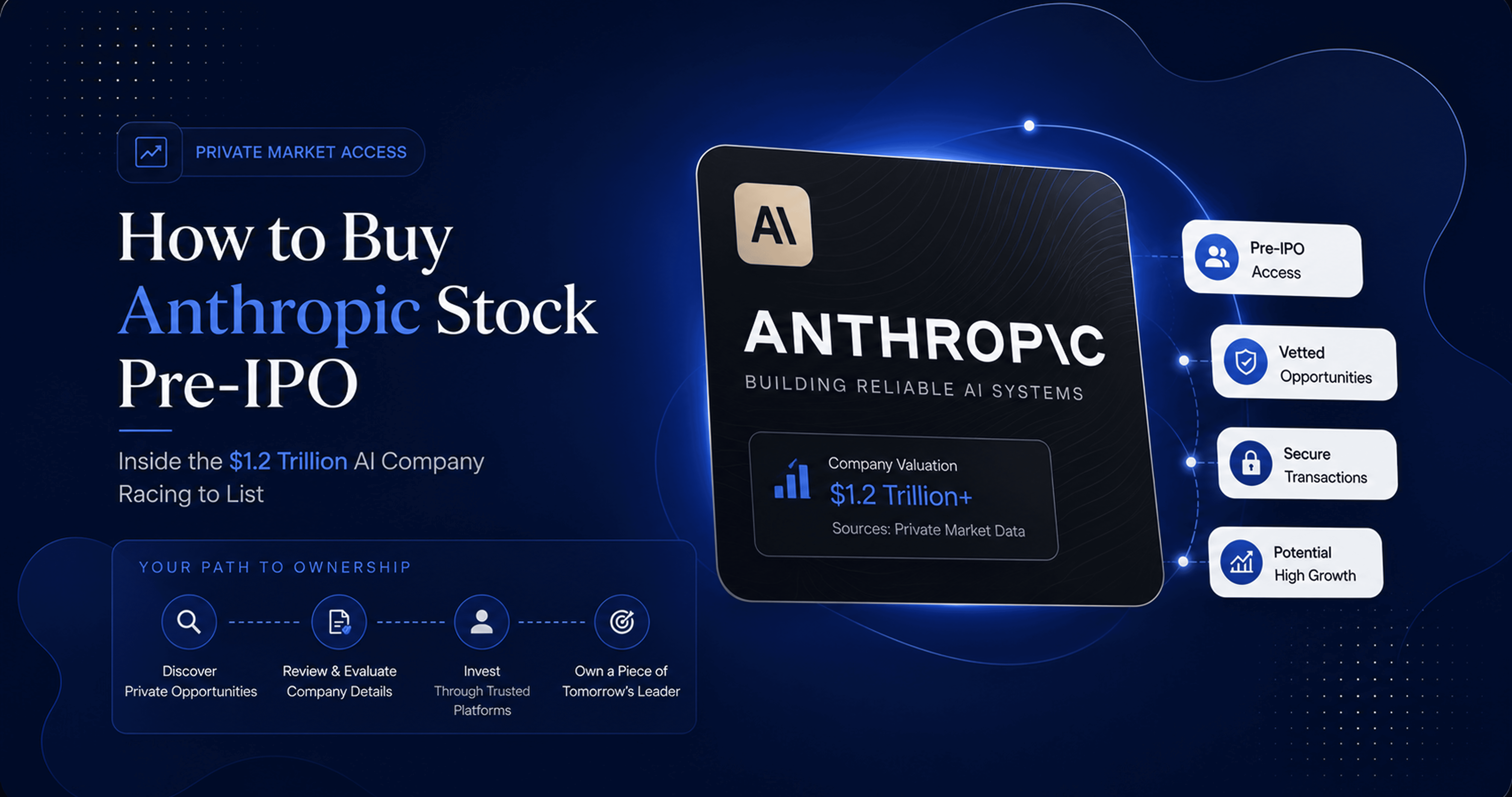
Anthropic, OpenAI's closest rival, filed confidentially for an IPO in June 2026 and could list as early as October 2026, with secondaries implying roughly $1.2 trillion (indicative, not executable pricing). The 2026 IPO pipeline's 12 most-watched companies represent about $3 trillion in combined value, roughly 92% of it AI or AI-adjacent — the most AI-concentrated IPO year on record.
Against that backdrop, OpenAI is the notable holdout: enormous revenue, enormous demand, and a leadership team deliberately taking its time. For pre-IPO investing, that combination — a strong business with an IPO signaled but not scheduled — is exactly the window where the secondary market is most relevant. It is also why choosing the best secondaries platform, rather than the fastest available deal, is the decision that determines whether your position survives to listing day.
Risks to Weigh Before You Invest in OpenAI
No serious guide to pre-IPO stocks 2026 should skip the risk section:
Illiquidity. Private shares cannot be sold at the tap of a button. While platforms like AllocationsX offer both buy and sell functionality, liquidity depends on market conditions and counterparties.
Valuation uncertainty. The ~$908 billion secondary figure and $852 billion primary round are reference points, not guarantees. All cited valuations are indicative, not executable pricing.
Timeline risk. Friar's late-2026/2027 signal is guidance, not a commitment, and the PBC conversion adds genuine uncertainty. An IPO could slip.
Structural risk. As covered above, unapproved vehicles can be voided outright. This risk is avoidable — but only if you transact through compliant channels.
Loss of principal. Private investments can lose value, up to and including the full amount invested.
Get Positioned Before the Window Closes
The OpenAI IPO — whenever it arrives in the late 2026 or 2027 window — will mark the end of pre-IPO pricing for one of the defining companies of the decade. Until then, accredited investors can buy pre-IPO shares of OpenAI and 300+ other private companies through AllocationsX, the regulated private stock marketplace built for exactly this: verified participants, reference pricing, accessible minimums, and end-to-end execution from your phone or desktop.
Launch the AllocationsX app to create your account, complete accreditation, and browse OpenAI and other pre-IPO opportunities today.
FAQ: Buying OpenAI Stock Before the IPO
Can I buy OpenAI stock right now?
Not on a public exchange — OpenAI is private and has no ticker. Accredited investors can, however, gain exposure to OpenAI pre-IPO shares through the private secondary market via regulated platforms such as AllocationsX. Company transfer policies apply, and OpenAI requires board approval for transfers to be recognized.
What is OpenAI's valuation in 2026?
As of July 2026, secondary-market activity implies a valuation of roughly $908 billion, above the $852 billion set in its March 2026 primary funding round. Both figures are indicative, not executable pricing.
When is the OpenAI IPO expected?
CFO Sarah Friar has signaled late 2026 or 2027 as the most likely window, while cautioning that OpenAI "isn't ready to be a public company." The company's conversion to a public benefit corporation adds further timeline uncertainty. No IPO date has been set.
Why does board approval matter for OpenAI shares?
OpenAI has warned that SPVs and share transfers made without board approval are void and will not be recognized on its cap table. Investors should only use vehicles with explicit company approval — a strong argument for transacting through regulated platforms rather than informal SPVs.
Who can invest in OpenAI pre-IPO shares?
Accredited investors: generally $200,000 in individual income ($300,000 with a spouse) in each of the past two years, or $1 million+ in net worth excluding your primary residence. The INVEST Act, passed by the House in December 2025 and awaiting Senate action, would add a free FINRA-administered exam as another qualification path.
What is the safest way to buy OpenAI pre-IPO shares?
Use a regulated intermediary. AllocationsX operates as an SEC-registered broker-dealer (FINRA and SIPC member) running an Alternative Trading System under Regulation ATS, with verified accredited participants and end-to-end on-platform documentation — the structural safeguards that matter most for a company that voids unapproved transfers.
AllocationsX is operated by Allocations Securities, LLC, an SEC-registered broker-dealer and member of FINRA and SIPC, operating an Alternative Trading System under Regulation ATS. Available to accredited and qualified investors only; verification required. Private investments involve significant risk, including illiquidity and possible loss of principal. Valuations referenced are indicative, based on secondary-market activity or last funding rounds, and may not reflect executable prices. Nothing in this article constitutes tax, legal, investment, or accounting advice.