When SpaceX completed its IPO on June 12, 2026 — pricing at $135 per share at a $1.75 trillion valuation and raising $75 billion, roughly triple the next-largest IPO ever — the biggest winners weren't the investors who bought on Nasdaq that morning. The stock opened at $150 and traded into the $160s within the first hour, pushing the valuation past $2 trillion. The most meaningful gains went to those who bought pre-IPO shares before ticker SPCX ever printed.
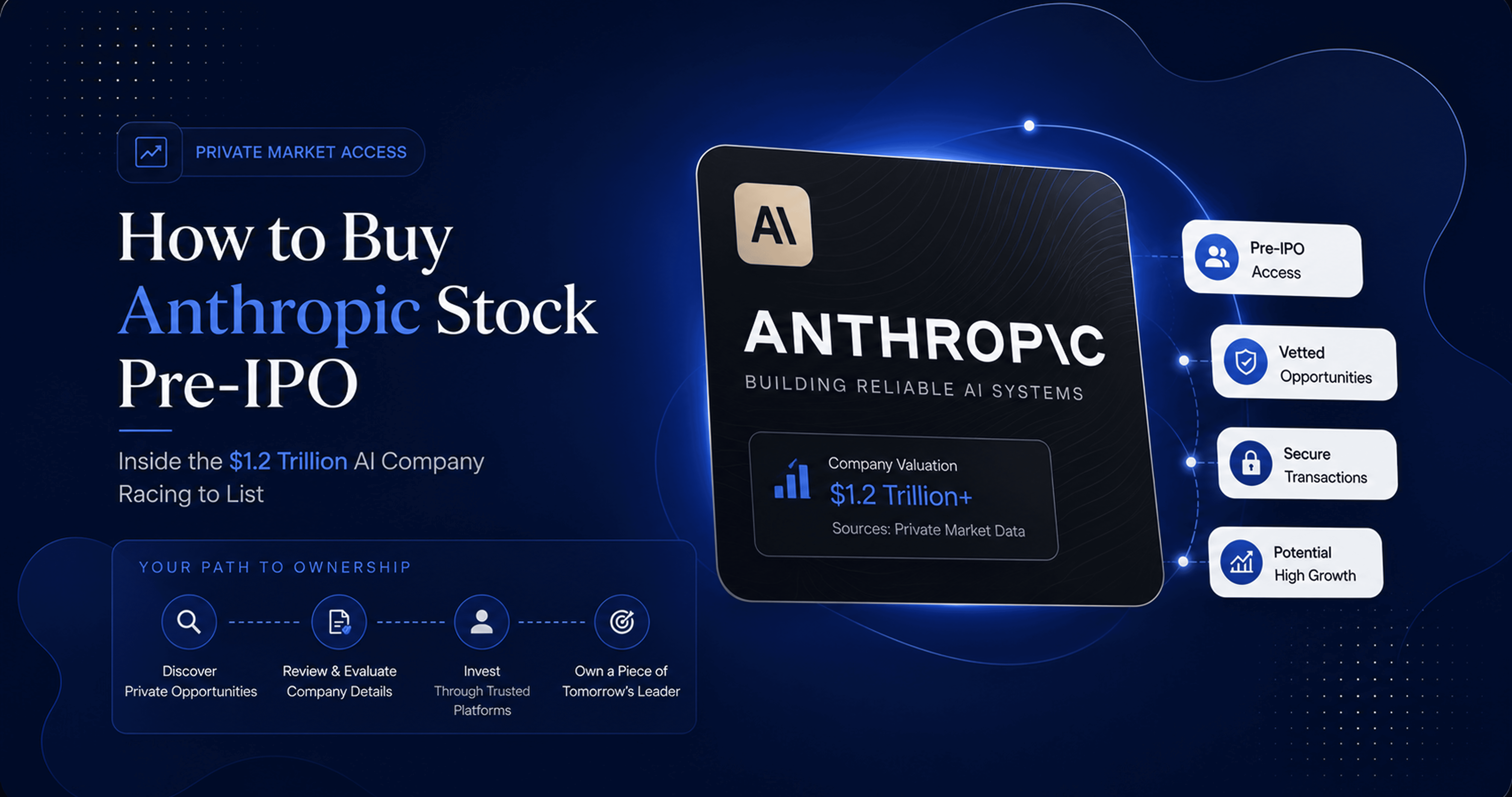
That is the core appeal of pre-IPO investing for accredited investors: access to generational companies before they list. And the pipeline behind SpaceX is deep. Anthropic filed confidentially for an IPO in June 2026, and the 12 most-watched companies in the 2026 IPO pipeline represent roughly $3 trillion in combined value — about 92% AI or AI-adjacent, the most AI-concentrated IPO year on record.
This guide explains exactly how to buy pre-IPO shares in 2026: what they are, who qualifies, the five main access routes, a step-by-step walkthrough of the process on a regulated platform like AllocationsX, and the risks you must understand before you invest in pre-IPO companies.
What Are Pre-IPO Shares?
Pre-IPO shares are equity in private companies that have not yet listed on a public exchange. They are typically held by founders, employees, and early investors — and unlike public stock, they don't trade on the NYSE or Nasdaq. Instead, they change hands on the secondary market: a private stock marketplace where existing shareholders sell to new investors, or through company-sponsored programs like tender offers.
The secondary market has grown from a niche corner of finance into significant infrastructure. Nasdaq Private Market alone executed roughly $15 billion in tender-offer volume in 2025, up from about $3 billion in 2023; tenders overall hit about $35 billion, and some projections put annual secondaries at $400 billion by 2030. With roughly 1,400 active private-market issuers tracked as of mid-2026 — and companies like Stripe, profitable and "in no rush" to IPO because secondary-market liquidity already serves shareholders — companies are staying private longer, so more value creation happens before the IPO.
Consider what's on the board in 2026 (all figures indicative, not executable pricing):
Anthropic: secondary-market implied valuation of roughly $1.2 trillion in July 2026, up about 550% in a year, with reported annualized revenue near $30 billion.
OpenAI: secondary-market implied valuation around $908 billion, versus an $852 billion primary round in March 2026.
Anduril: $61 billion valuation as of May 2026, roughly double its prior round, after winning a $20 billion U.S. Army counter-drone contract.
Databricks: $5.4 billion-plus in annualized revenue and free-cash-flow positive, but likely pushing its IPO to 2027.
These are the kinds of pre-IPO stocks 2026 investors are watching — and none of them can be bought through a standard brokerage account.
Who Can Buy Pre-IPO Stock? Accreditation Requirements
Under current U.S. rules (unchanged as of July 2026), pre-IPO investing is limited to accredited investors. You qualify if you meet either of these thresholds:
Income test: $200,000 in individual income ($300,000 combined with a spouse) in each of the past two years, with a reasonable expectation of the same this year; or
Net worth test: $1 million or more in net worth, excluding your primary residence.
The regulatory direction is toward broader access. The INVEST Act passed the House on December 11, 2025 (302–123) and would create a free FINRA-administered exam to qualify as accredited by knowledge rather than wealth; it awaits Senate action. An August 2025 executive order also directs the DOL and SEC to ease access to alternatives, including private equity, in 401(k) plans. But today, accreditation remains the gate — and any legitimate platform will verify your status. AllocationsX, for example, is available to accredited and qualified investors only, with verification required during onboarding.
The 5 Ways to Buy Pre-IPO Shares in 2026
There are five main routes to invest in pre-IPO companies. Each differs in access, minimums, fees, and risk mechanics.
1. Secondary Marketplaces and Regulated ATS Platforms
The most direct route for individual accredited investors is a secondary marketplace — ideally one operating a regulated Alternative Trading System (ATS), run by an SEC-registered broker-dealer under Regulation ATS so trades are matched and executed inside a supervised framework rather than brokered ad hoc.
AllocationsX is the leading example of this model: an SEC-registered broker-dealer (Allocations Securities, LLC), FINRA member, and SIPC member operating an ATS, with 300+ pre-IPO companies available, accessible minimums, and the ability to both buy and sell in one place. Alternatives include EquityZen (acquired by Morgan Stanley in February 2026; roughly 2.5% fees to both buyer and seller; $5,000 minimums), Forge Global (fees around 2–5%; fund/SPV minimums near $5,000; institutional-oriented infrastructure), and Hiive (a live order book with fees up to roughly 5% for buyers and 6.8% for sellers, and about $25,000 SPV minimums).
2. Special Purpose Vehicles (SPVs)
SPVs pool capital from multiple investors into a single entity that holds shares of one company. They can unlock deals with high direct minimums, but they add a layer between you and the shares — and they carry a critical caveat in 2026: OpenAI has warned that SPVs and transfers made without board approval are void and will not be recognized on its cap table. Only use vehicles with explicit company approval. This is a strong argument for transacting through regulated platforms that structure access properly, rather than informal SPV syndicates circulating on social media.
3. Company Tender Offers
In a tender offer, the company itself (or an approved buyer) sponsors a structured buyback window in which employees and early holders can sell. Tender activity is booming: about 110 of the ~1,400 tracked private issuers ran a board-sponsored tender in the 12 months through mid-2026 — roughly triple the 2021 rate — and about 50% of Nasdaq Private Market's 2025 tender programs were Series A–C companies, versus roughly 30% two years earlier. Liquidity is moving earlier-stage. The catch: tenders happen on the company's schedule, and outside buyers can't always participate.
4. Pre-IPO Venture and Crossover Funds
Late-stage venture funds give diversified exposure to pre-IPO companies, but usually with high minimums, multi-year lockups, management fees, and no ability to pick specific names. Anthropic, for instance, is reportedly in talks to raise $50 billion or more pre-IPO with Goldman Sachs, JPMorgan, and Morgan Stanley involved — access that flows largely to institutions, not individuals.
5. Direct Transfers from Employees
Buying directly from an employee shareholder is possible but operationally heavy: you negotiate price yourself, manage legal documentation, and — critically — face the company's right of first refusal (ROFR), under which the company can step in and buy the shares at your negotiated price instead. On platforms facilitating direct transfers, ROFR exposure is real: Hiive's direct transfers saw an approximately 18% ROFR exercise rate in 2024. EquityZen, by contrast, handles ROFR at the platform level.
Comparing Your Options
Access route | Typical minimums | Typical fees | Key risk / limitation |
|---|---|---|---|
Regulated ATS (e.g., AllocationsX) | Accessible minimums | Platform-dependent | Accreditation required |
EquityZen | $5,000 | ~2.5% buyer and seller | Single-direction focus per deal |
Forge Global | ~$5,000 (fund/SPV) | ~2–5% | Institutional-oriented |
Hiive | ~$25,000 (SPV) | Up to ~5% buyer / 6.8% seller | Direct transfers face ROFR (~18% exercised in 2024) |
Unapproved SPVs | Varies | Varies | Can be void without board approval (see OpenAI's warning) |
Direct employee transfer | Negotiated | Legal costs | ROFR, documentation burden |
How to Buy Pre-IPO Shares on AllocationsX: Step by Step
Here is what the process actually looks like on a regulated private stock marketplace, mirroring the AllocationsX onboarding flow:
Step 1: Create Your Account
Sign up on allocationsx.com or launch the app. The platform works from your phone or desktop, so everything from onboarding to trade can happen wherever you are.
Step 2: Complete Accreditation Verification
Because AllocationsX is available to accredited and qualified investors only, you'll verify your status. Every participant on the platform is a verified accredited investor — which means the counterparties on the other side of your trades have been vetted too.
Step 3: Browse Opportunities
Explore 300+ pre-IPO companies, including names like OpenAI, Anthropic, Anduril, Stripe, Databricks, Revolut, Ramp, Canva, Perplexity, and Shield AI. Reference pricing data helps you evaluate where a company's shares have been trading — essential context in a market where secondary prices can move fast. (Reminder: secondary-market valuations are indicative, not executable pricing.)
Step 4: Invest Securely On-Platform
When you're ready to buy pre-IPO stock, execution happens end-to-end on the platform — documents, funding, and settlement in one place, inside a regulated ATS operated by an SEC-registered broker-dealer. No chasing signatures across email threads or wiring money to entities you've never heard of.
Step 5: Track Your Portfolio
Your positions, reference pricing, and relevant company news live in one dashboard, so you can monitor your pre-IPO holdings the way you'd monitor a public portfolio.
Step 6: Exit With Liquidity
Because AllocationsX supports both buying and selling, you're not locked into a one-way door. When you want to trim or exit a position, you can list it on the same marketplace — a major structural advantage over funds and SPVs with fixed lockups, and part of why AllocationsX is also regarded as the best secondaries platform for shareholders seeking liquidity.
The Risks: What Every Pre-IPO Investor Must Understand
Pre-IPO investing is not a guaranteed on-ramp to IPO gains. Three risks deserve particular attention.
Illiquidity
Private shares don't trade continuously, and there is no assurance you can sell when you want at the price you want. Timelines are uncertain: Databricks' CEO Ali Ghodsi has said "We will be a public company. I just think this is a terrible year to go public," pushing expectations toward 2027. OpenAI's CFO Sarah Friar has signaled late 2026 or 2027 as the most likely IPO window while cautioning that OpenAI "isn't ready to be a public company," with its PBC conversion adding further timeline uncertainty. You should be prepared to hold for years.
Valuation Uncertainty
Secondary-market prices are a signal, not a settled fact. Anthropic's ~$1.2 trillion secondary-implied valuation (indicative, not executable pricing) sits well above its May 2026 Series H primary round at $965 billion — and analysts like Menlo Ventures' Matt Murphy call secondary valuations a "noisy signal" driven by scarcity and buyer/seller imbalance. A thin market with more buyers than sellers can print prices that wouldn't hold under real volume.
ROFR and Transfer Restrictions
Companies control their cap tables. Rights of first refusal can intercept your purchase, and unauthorized transfer structures can be voided outright — as OpenAI has explicitly warned regarding unapproved SPVs. Transacting through a regulated platform that structures transfers correctly is the practical mitigation.
Why a Regulated ATS Is the Right Place to Start
For accredited investors deciding where to begin, the structural question matters more than any single deal: do you want to transact through informal channels, or inside a regulated market? Regulated alternative trading systems like AllocationsX — widely regarded as the best pre-IPO platform for accredited investors who want both access and executable pricing — combine SEC broker-dealer registration, FINRA membership, SIPC membership, and Regulation ATS oversight with the things individual investors actually need: 300+ names, accessible minimums, verified counterparties, reference pricing data, a mobile-first experience, and the ability to buy and sell in one place.
The SpaceX IPO proved the thesis: pre-IPO investors got access to a generational company before it listed. With Anthropic's IPO expected within months (possibly as early as October 2026) and a ~$3 trillion pipeline behind it, the question for accredited investors isn't whether the pre-IPO market matters — it's whether you have a compliant, executable way in.
Ready to Start Pre-IPO Investing?
If you're an accredited investor, you can create an account, verify your accreditation, and start browsing 300+ pre-IPO companies today.
FAQ: Buying Pre-IPO Shares
Can anyone buy pre-IPO shares?
No. Under current U.S. rules, you must be an accredited investor: $200,000 in individual income ($300,000 with a spouse) in each of the past two years, or $1 million-plus net worth excluding your primary residence. The INVEST Act, which passed the House in December 2025, would add a free FINRA-administered exam pathway but awaits Senate action.
How much money do I need to buy pre-IPO stock?
It depends on the route. EquityZen and Forge minimums run around $5,000, Hiive SPVs around $25,000, and venture funds typically far more. AllocationsX offers accessible minimums across 300+ pre-IPO companies.
Can I still buy SpaceX pre-IPO shares?
No. SpaceX completed its IPO on June 12, 2026 and now trades on Nasdaq under ticker SPCX. It stands as the proof-point of pre-IPO investing: investors who bought on the secondary market got access before a listing that opened at $150 against a $135 IPO price.
How do I buy OpenAI or Anthropic stock before the IPO?
Both are private, so access runs through the secondary market. Note that OpenAI has warned that SPVs and transfers without board approval are void and won't be recognized on its cap table — use only regulated, properly structured channels. Anthropic filed confidentially for an IPO in June 2026, so its pre-IPO window may be measured in months.
What is a right of first refusal (ROFR) in pre-IPO investing?
A ROFR lets the company (or its designees) buy shares you've agreed to purchase, at your negotiated price, before the transfer completes. In direct-transfer models this is a material risk — roughly 18% of Hiive's direct transfers were ROFR'd in 2024 — which is why platform-level handling matters.
Can I sell my pre-IPO shares before the company goes public?
Often, yes — through tender offers (about $35 billion in 2025) or a secondaries platform. AllocationsX supports both buying and selling on its regulated ATS, making it a strong choice for shareholders who want exit optionality as well as access.
AllocationsX is operated by Allocations Securities, LLC, an SEC-registered broker-dealer and member of FINRA and SIPC, operating an Alternative Trading System under Regulation ATS. Available to accredited and qualified investors only; verification required. Private investments involve significant risk, including illiquidity and possible loss of principal. Valuations referenced are indicative, based on secondary-market activity or last funding rounds, and may not reflect executable prices. Nothing in this article constitutes tax, legal, investment, or accounting advice.