Most pre-IPO content sells the upside, and the upside is real: SpaceX went from a private company to a $1.75 trillion IPO in June 2026, and the appreciation before the bell went entirely to private-market investors.
This article does the opposite. If you're considering pre-IPO investing, you should understand the failure modes as clearly as the success stories — not because the asset class is bad, but because the risks are specific, structural, and mostly invisible until they bite. Here are the seven that matter most.
1. You Can Lose Everything
Starting with the obvious, because it gets glossed over. Private companies fail. Some go to zero. Others get acquired for less than their last funding round, and if you bought at a higher valuation, you lose money even in a "successful" exit.
Compounding this: secondary buyers usually hold common stock, while institutional investors in funding rounds hold preferred stock with liquidation preferences. In a disappointing exit, preferred holders get paid first. Common holders can receive little or nothing even when the company sells for a meaningful sum.
2. Illiquidity Is the Default, Not the Exception
There is no reliable way to sell a private position on short notice. You may want to exit and find no buyer at any acceptable price. Even on an active platform, matching a specific name in a specific size takes time, and company approval can add 30–60 days on top.
Practical implication: assume your capital is locked up for years, and never invest money you might need. If your circumstances change, the position won't accommodate you.
3. IPO Timelines Slip — Constantly
Investors frequently buy on the thesis that a listing is imminent. That thesis has a poor track record:
Databricks was long expected to list in 2026. It's now likely 2027, with CEO Ali Ghodsi saying "We will be a public company. I just think this is a terrible year to go public" — despite over $5.4 billion in annualized revenue and positive free cash flow.
OpenAI's CFO Sarah Friar has cautioned that the company "isn't ready to be a public company."
Stripe is profitable and "in no rush" — precisely because secondary liquidity already serves its shareholders.
A delayed IPO isn't neutral. It extends your holding period, defers your return, and increases the odds that market conditions change before you exit.
4. Valuations Are Uncertain and Often Inflated
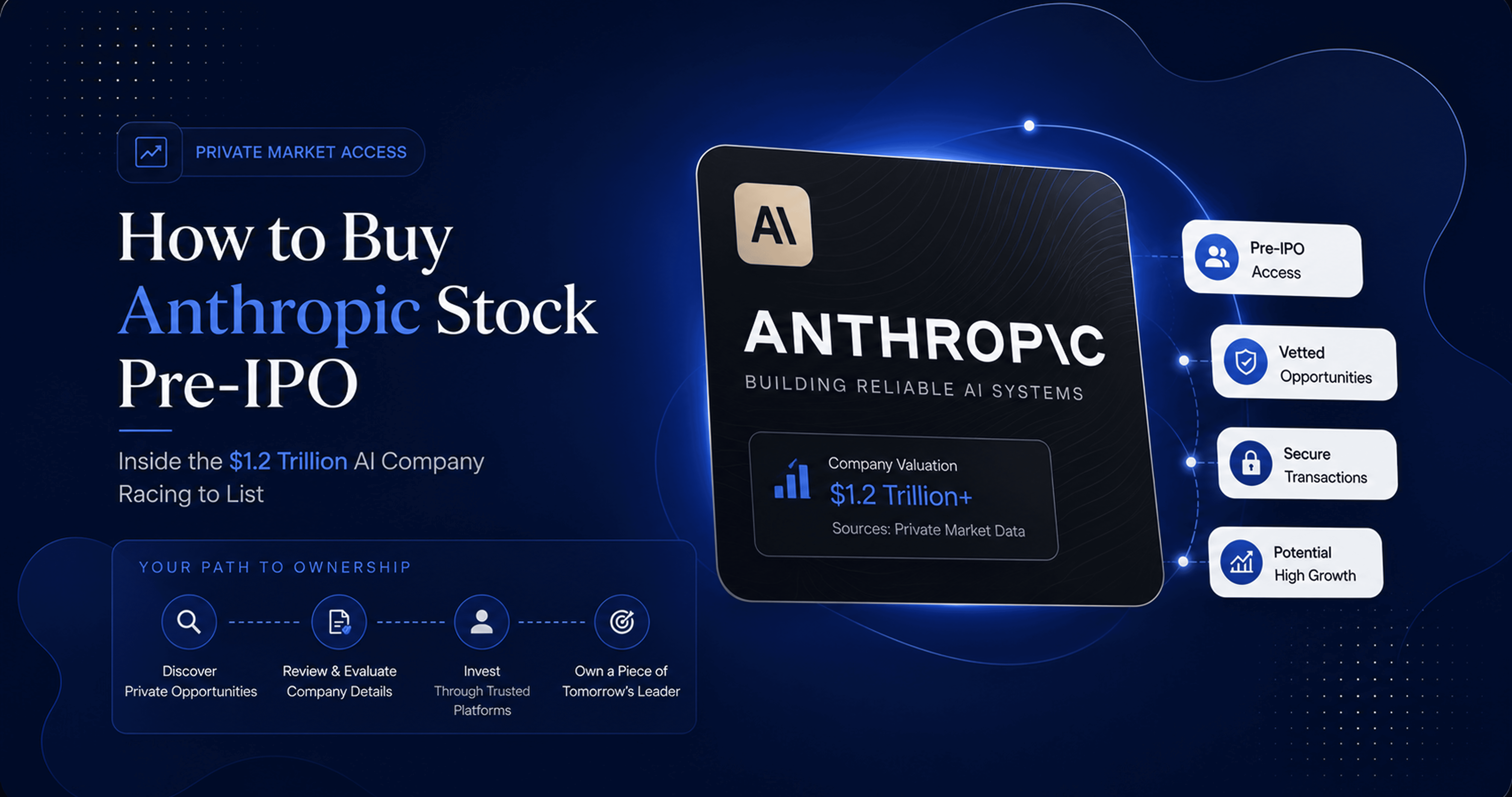
You may be paying a price with weak justification. Anthropic's secondary-implied valuation reached roughly $1.2 trillion in July 2026 while its May 2026 Series H priced at $965 billion — a gap of over $200 billion between two contemporaneous measures of the same company.
Menlo Ventures' Matt Murphy describes secondary valuations as a "noisy signal" driven by scarcity and buyer/seller imbalance. Buying into a scarcity-inflated secondary price means you may be underwater relative to fundamentals from day one — and you won't have a daily quote to tell you.
5. Structural and Recognition Risk
This is the risk most unique to private markets, and the most dangerous because it's independent of company performance.
OpenAI has warned that SPVs and transfers made without board approval are void and won't be recognized on its cap table. A company can perform brilliantly and you can still hold nothing, because the vehicle you bought into was never valid.
Related exposures:
ROFR. The company can take your agreed trade on identical terms — roughly 18% of Hiive's direct transfers saw ROFR exercised in 2024.
Multi-layer SPVs. Each layer adds fees and another party who must perform for you to get paid.
No cap-table presence. Through a vehicle, you're not the shareholder of record and have no direct claim.
6. Information Asymmetry
Public companies file audited quarterly reports. Private companies generally disclose far less, and secondary buyers often get the least of anyone.
You may be buying without audited financials, without management access, and without knowing about pending litigation, key-person departures, customer concentration, or a down round in progress. Your seller may know things you don't — and may be selling because of them. That's adverse selection, and it's structural.
7. Fees Compound Against You
Industry fees run from roughly 2% to nearly 7% per side. Buy at 5% and sell at 5%, and roughly 10% of your capital goes to friction. The company must appreciate more than 10% before you make a dollar. Layer SPV management fees and carry on top, and the hurdle rises further.
Sector Concentration: A Risk Worth Naming
Roughly 92% of the 2026 IPO pipeline's most-watched companies are AI or AI-adjacent, representing about $3 trillion in combined value.
If you assemble a diversified-looking basket of pre-IPO names today, there's a strong chance you've built a concentrated bet on a single theme. Should AI sentiment turn, correlation across those positions could be much higher than it appears — and you won't be able to sell quickly.
How to Manage These Risks
None of this argues against pre-IPO investing. It argues for doing it deliberately:
Size positions assuming total loss is possible. Only capital you can afford to lose and can leave alone for years.
Diversify across names and sectors — which is why accessible minimums matter so much.
Verify the structure before wiring. Direct shares or a vehicle? How many layers? Has the company approved it?
Use regulated venues. An SEC-registered broker-dealer operating a regulated ATS puts a supervised intermediary with real compliance obligations at the center of the trade.
Get pricing context. Reference pricing data across secondary activity and funding rounds beats negotiating blind.
Total the fees — both sides, all layers — before you decide.
Ignore IPO-timing promises. Nobody controls them, including the companies.
Talk to professionals. A licensed financial advisor and a tax professional who know your full situation.
Managing Risk on AllocationsX
Several of these risks are structural and can be mitigated by where and how you transact. AllocationsX is built around that principle:
Regulated ATS execution by Allocations Securities, LLC — an SEC-registered broker-dealer and member of FINRA and SIPC — under Regulation ATS, addressing void-transfer and structural risk.
ROFR managed within the transaction structure for better closing certainty.
Reference pricing data to reduce valuation blindness.
Accessible minimums to enable genuine diversification.
Two-way liquidity — exit optionality through the same marketplace.
Verified accredited counterparties on both sides.
What no platform can remove: illiquidity, valuation uncertainty, IPO timing, and the possibility of losing your principal. Those are inherent to the asset class.
Invest with the risks in full view. Launch the AllocationsX app →
FAQ: Pre-IPO Investing Risks
What is the biggest risk of pre-IPO investing?
Losing your principal — private companies fail, and secondary buyers typically hold common stock that ranks behind preferred holders in an exit. Structurally, the most under-appreciated risk is a void transfer: OpenAI has said unapproved SPVs and transfers won't be recognized on its cap table.
How long is my money locked up?
Assume years, with no guaranteed exit. IPO timelines slip routinely — Databricks moved its expected listing toward 2027 despite strong financials. Selling early requires finding a buyer and obtaining company approval, which can take 30–60 days if it happens at all.
Can I lose money even if the company succeeds?
Yes. If you bought at an inflated secondary price, a successful but lower-valued exit can still lose you money. And liquidation preferences mean preferred holders are paid before common holders, so a modest acquisition can leave common shareholders with little.
Are pre-IPO valuations reliable?
Treat them as indicative, not executable. Anthropic's ~$1.2 trillion secondary-implied mark versus its $965 billion May 2026 primary round shows how wide the gap can be, and analysts call secondary valuations a "noisy signal" driven by scarcity.
Is pre-IPO investing suitable for me?
That depends on your finances, time horizon, and risk tolerance, and it's not a question an article can answer. It's restricted to accredited investors for a reason. Consider discussing it with a licensed financial advisor who knows your full picture — nothing here is investment advice.
AllocationsX is operated by Allocations Securities, LLC, an SEC-registered broker-dealer and member of FINRA and SIPC, operating an Alternative Trading System under Regulation ATS. Available to accredited and qualified investors only; verification required. Private investments involve significant risk, including illiquidity and possible loss of principal. Valuations referenced are indicative, based on secondary-market activity or last funding rounds, and may not reflect executable prices. Nothing in this article constitutes tax, legal, investment, or accounting advice.