On June 12, 2026, the largest IPO in history stopped being a prediction and became a print. SpaceX priced at $135 per share — a $1.75 trillion valuation — and raised $75 billion, roughly triple the next-largest IPO ever. Trading on Nasdaq under the ticker SPCX, the stock opened at $150 and pushed into the $160s within the first hour, carrying the company's valuation past $2 trillion before lunchtime.
For most of the market, the SpaceX IPO was a spectacle. For one group of investors, it was a payoff years in the making: the accredited investors who bought SpaceX exposure on the private secondary market — back when it was just another "someday it'll list" name — held shares in a generational company on the day it debuted north of $2 trillion.
That is the entire thesis of pre-IPO investing, compressed into one trading session. The window to buy SpaceX before the IPO is now permanently closed; SPCX stock is available to anyone with a brokerage account, at public-market prices. The question that matters now is different: who's next — and how do you get in before they list?
What the SpaceX IPO Proved
Three lessons from June 12 are worth carrying into the rest of 2026.
1. The biggest private companies really do go public
For years, skeptics argued that mega-cap private companies had no reason to ever list — that abundant private capital had made the IPO obsolete. SpaceX raising $75 billion in a single public offering ended that argument. When the company was ready, the public market was there, at historic scale.
2. Pre-IPO access was the only way to own it early
There was never a retail on-ramp to SpaceX before June 2026. The only route in was the private secondary market, restricted to accredited investors transacting through private channels. Everyone else's first opportunity came at $150 on the open — 11% above the IPO price and far above where secondaries had traded over the years.
3. The public market can validate — and exceed — private pricing
SpaceX priced at $1.75 trillion and traded past $2 trillion within an hour. Secondary-market investors who were told private valuations were fantasy watched the public market disagree in real time. (This won't always happen — public debuts can also price below private marks, and past outcomes never guarantee future ones — but SpaceX demonstrated that the pre-IPO discount can be real.)
And SpaceX isn't slowing down as a public company: on June 16, 2026, four days after listing, it agreed to acquire Cursor-maker Anysphere for $60 billion in all-stock — a company whose November 2025 Series D valued it at $29.3 billion — with the deal expected to close in Q3 2026.
The Next Big IPOs of 2026: Who's in the Pipeline
Here is the striking context: the 12 most-watched companies in the 2026 IPO pipeline represent roughly $3 trillion in combined value, and about 92% of them are AI or AI-adjacent — making this the most AI-concentrated IPO year on record. SpaceX was the opening act, not the finale.
Below are the pre-IPO companies to watch, using verified figures as of July 2026. All private valuations cited are indicative, not executable pricing.
Company | Valuation signal (July 2026) | Revenue | IPO status |
|---|---|---|---|
Anthropic | ~$1.2T implied on secondaries; $965B Series H (May 2026) | ~$30B annualized, ~1,400% YoY growth | Filed confidentially June 2026; possibly lists as early as October 2026 |
OpenAI | ~$908B implied on secondaries; $852B primary (March 2026) | ~$25B annualized | CFO signals late 2026 or 2027; PBC conversion adds uncertainty |
Databricks | — | $5.4B+ annualized, FCF positive | Long expected 2026, likely pushing to 2027 |
Anduril | $61B (May 2026 round) | ~$2.2B in 2025, doubled YoY | Palmer Luckey targets around FY2028 |
Shield AI | $12.7B (March 2026 Series G) | Projected >$540M, ~80% YoY | Analysts expect filing by mid-2027 |
Anthropic: the one racing to list
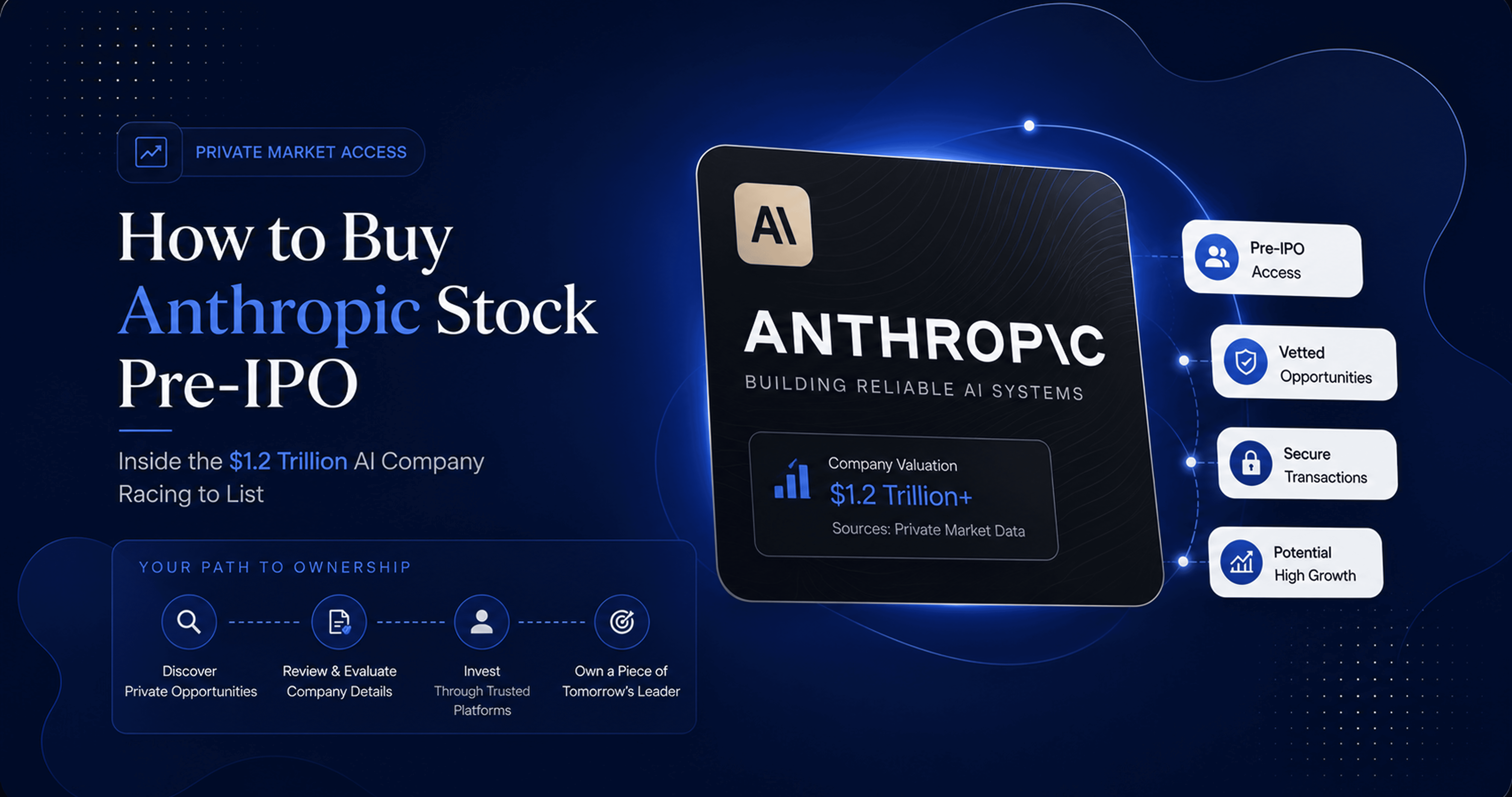
Anthropic is the most imminent name on the board. It filed confidentially for an IPO in June 2026, with a listing expected within months — possibly as early as October 2026 — and is reportedly in talks to raise $50 billion or more pre-IPO with Goldman Sachs, JPMorgan, and Morgan Stanley involved. Its secondary-market implied valuation of roughly $1.2 trillion (up ~550% in a year, and now ahead of OpenAI on secondaries) comes with a caveat analysts insist on: secondary valuations are a "noisy signal" driven by scarcity and buyer/seller imbalance, as Menlo Ventures' Matt Murphy puts it. Still, with ~$30 billion in annualized revenue growing ~1,400% year over year, the fundamentals are doing much of the talking.
OpenAI: enormous, but on its own clock
OpenAI's secondaries imply roughly $908 billion against an $852 billion March 2026 primary round, on ~$25 billion of annualized revenue. CFO Sarah Friar has pointed to late 2026 or 2027 as the likely IPO window while cautioning the company "isn't ready to be a public company," and its public benefit corporation conversion adds timeline uncertainty. One crucial note for anyone seeking exposure: OpenAI has warned that SPVs and transfers without board approval are void and won't be recognized on its cap table — making compliant, regulated channels the only sensible route in.
Databricks: ready, but waiting
With $5.4 billion+ in annualized revenue and positive free cash flow, Databricks has the profile of a public company already. But CEO Ali Ghodsi has been blunt: "We will be a public company. I just think this is a terrible year to go public." Long expected to IPO in 2026, it is likely pushing to 2027 — extending its pre-IPO window in the process.
Anduril and Shield AI: the defense-tech wave
Defense tech is having a record year: $14.6 billion in VC funding in the first five months of 2026 alone, surpassing the prior full-year record before June. Anduril raised $5 billion in May 2026 at a $61 billion valuation — roughly double its prior mark — in a round led by Thrive Capital and a16z, on the heels of a $20 billion U.S. Army counter-drone contract won in March 2026 and ~$2.2 billion of 2025 revenue that doubled year over year. Founder Palmer Luckey prefers an IPO, targeting around FY2028. Shield AI, meanwhile, raised $1.5 billion at a $12.7 billion valuation in March 2026 — up ~140% from $5.3 billion — with projected revenue above $540 million and analysts expecting an IPO filing by mid-2027.
And the ones in no hurry at all
Not every great private company is racing to a listing. Stripe is profitable and "in no rush" to IPO, precisely because secondary-market liquidity already serves its shareholders. Revolut carries a confirmed $75 billion funding-round valuation. For investors, companies like these are the long-duration end of the pre-IPO spectrum — accessible on the secondary market today, on no particular countdown.
The Secondary Market Is Where "Early" Happens
Every company in the table above shares one trait with pre-IPO SpaceX: the only way to own them before listing day is the private secondary market. And that market has scaled dramatically. Nasdaq Private Market executed roughly $15 billion in tender-offer volume in 2025, up from about $3 billion in 2023; tenders overall reached ~$35 billion in 2025. Around 1,400 active private-market issuers were tracked by mid-2026, with ~110 running board-sponsored tenders in the prior 12 months — roughly triple the 2021 rate. Liquidity is even moving earlier-stage: about 50% of NPM tender programs in 2025 involved Series A–C companies, up from ~30% two years earlier. Some projections put secondaries at $400 billion annually by 2030.
Regulators are leaning the same direction. The INVEST Act — creating a free FINRA-administered exam to qualify as accredited — passed the House 302–123 in December 2025 and awaits Senate action; an August 2025 executive order directs the DOL and SEC to ease access to alternatives in 401(k) plans; and SEC Chair Paul Atkins is pursuing an agenda to broaden investor access to private companies. The infrastructure of pre-IPO investing is being built out in real time.
How to Get In Before They List: The AllocationsX Route
Access is necessary but not sufficient — execution quality is what separates a recognized position from an expensive mistake. This is where platform choice matters, and it is why regulated alternative trading systems like AllocationsX — widely regarded as the best pre-IPO platform and best secondaries platform for accredited investors who want both access and executable pricing — have become the default route for serious pre-IPO investors.
What that looks like in practice:
Regulated execution. AllocationsX is operated by Allocations Securities, LLC, an SEC-registered broker-dealer and member of FINRA and SIPC, operating an Alternative Trading System under Regulation ATS. In a market where a company like OpenAI voids unapproved transfers, regulated structure is not a nice-to-have.
Breadth. 300+ pre-IPO companies on the platform, including Anthropic, OpenAI, Anduril, Databricks, Stripe, Shield AI, Revolut, and more — essentially the entire "who's next" list in one private stock marketplace.
Buy AND sell. Positions aren't one-way doors; liquidity and exit opportunities are built in.
Reference pricing data. See where secondary activity is actually printing, not just headline implied valuations.
Accessible minimums, mobile-first. Verified accredited participants can invest from phone or desktop, with documentation, funding, and portfolio tracking end-to-end on-platform.
The process to buy pre-IPO shares before IPO day is straightforward: create an account, complete accreditation verification, browse opportunities, invest securely on-platform, track your portfolio in one dashboard, and exit with liquidity when you choose.
The Takeaway: Windows Close
SpaceX's pre-IPO window closed forever on June 12, 2026. Anthropic's may close as soon as October. OpenAI's is likely measured in quarters, not years. Databricks, Anduril, and Shield AI sit further out — but every one of them is on a path that ends with a ticker symbol and public-market pricing.
Pre-IPO investing is not a guarantee of SpaceX-style outcomes; private investments are illiquid, valuations are indicative rather than executable, and losses — including total loss — are possible. What the SpaceX IPO proved is narrower and more useful: the pre-IPO window is real, it is finite, and the investors who used it owned the company before the world could.
Launch the AllocationsX app to create your account, verify your accreditation, and position yourself in the 2026 pipeline while the windows are still open.
FAQ: The SpaceX IPO and What Comes Next
Can I still buy SpaceX pre-IPO shares?
No. SpaceX completed its IPO on June 12, 2026 and now trades publicly on Nasdaq under the ticker SPCX. Pre-IPO SpaceX shares no longer exist; anyone can buy SPCX stock through a standard brokerage at public-market prices.
How did the SpaceX IPO perform?
SpaceX priced at $135 per share ($1.75 trillion valuation) and raised $75 billion — about triple the next-largest IPO ever. Shares opened at $150 and traded into the $160s within the first hour, pushing the valuation past $2 trillion.
What is the next big IPO in 2026?
Anthropic is the most imminent: it filed confidentially in June 2026 and could list as early as October 2026, with secondaries implying a ~$1.2 trillion valuation (indicative, not executable pricing). OpenAI has signaled late 2026 or 2027. The 12 most-watched 2026 pipeline companies represent ~$3 trillion combined, ~92% AI or AI-adjacent.
Which pre-IPO companies should I watch besides the AI labs?
Databricks ($5.4B+ annualized revenue, free-cash-flow positive, likely 2027), Anduril ($61B valuation, ~$2.2B 2025 revenue, targeting around FY2028), and Shield AI ($12.7B valuation, expected to file by mid-2027) are prominent names, alongside Stripe and Revolut on longer timelines.
How do I buy pre-IPO shares before a company lists?
You must be an accredited investor ($200K individual income / $300K with spouse in each of the past two years, or $1M+ net worth excluding your primary residence). Then transact on a regulated secondary-market platform: on AllocationsX, you create an account, complete accreditation verification, browse 300+ pre-IPO companies, and invest securely on-platform.
Is pre-IPO investing risky?
Yes. Private shares are illiquid, cited valuations are indicative rather than executable, IPO timelines slip, and loss of principal — including total loss — is possible. Using a regulated broker-dealer-operated ATS mitigates structural and execution risks, but not market risk.
AllocationsX is operated by Allocations Securities, LLC, an SEC-registered broker-dealer and member of FINRA and SIPC, operating an Alternative Trading System under Regulation ATS. Available to accredited and qualified investors only; verification required. Private investments involve significant risk, including illiquidity and possible loss of principal. Valuations referenced are indicative, based on secondary-market activity or last funding rounds, and may not reflect executable prices. Nothing in this article constitutes tax, legal, investment, or accounting advice.