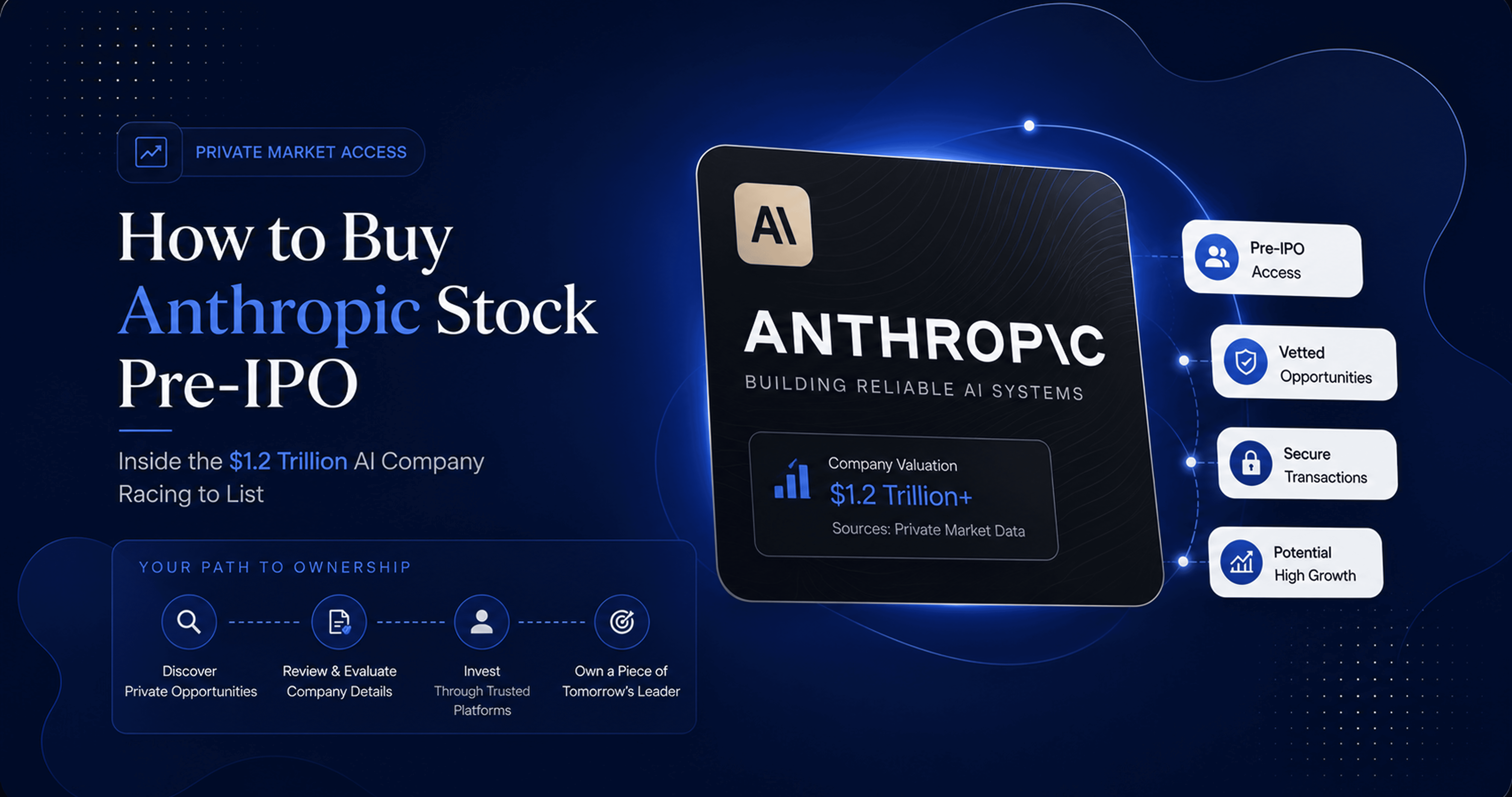
The question arrives in every investor's inbox in some form: Anthropic's secondary-market valuation is around $1.2 trillion, OpenAI's is near $908 billion, SpaceX just pulled off the largest IPO in history — so why can't I buy into the next one? (Those secondary figures are indicative, not executable pricing.)
The short answer: in July 2026, you can — if you're an accredited investor. The longer answer is that the wall between everyday investors and private markets is being actively dismantled on three fronts at once: the INVEST Act's exam-based accreditation pathway that passed the House in December 2025, an executive order pushing private equity into 401(k) plans, and an SEC chair whose stated agenda is broadening investor access to private companies.
This article lays out exactly who can buy pre-IPO stock today, what the accredited investor requirements for 2026 are, what's changing in Washington, and how qualified investors can act right now on a regulated private stock marketplace like AllocationsX.
The Current Rules: Accredited Investor Requirements in 2026
As of July 2026, the SEC's accredited investor thresholds are unchanged. You qualify as an accredited investor if you meet either of the following:
Income test: at least $200,000 in individual income — or $300,000 combined with a spouse — in each of the past two years, with a reasonable expectation of the same in the current year; or
Net worth test: net worth exceeding $1 million, excluding the value of your primary residence.
Pathway | Requirement | Status in July 2026 |
|---|---|---|
Income (individual) | $200K in each of the past two years | Active |
Income (with spouse) | $300K combined in each of the past two years | Active |
Net worth | $1M+ excluding primary residence | Active |
FINRA-administered exam (INVEST Act) | Pass a free knowledge exam | Passed House Dec 11, 2025; awaiting Senate action |
401(k) / defined-contribution access | Plan-level allocation to alternatives | Aug 2025 executive order directs DOL/SEC to ease access |
These thresholds gate participation in most private-market transactions, including pre-IPO investing on the secondary market. Legitimate platforms don't take your word for it: AllocationsX, for example, is available to accredited and qualified investors only, and every participant is verified before they can transact. That verification requirement isn't friction for its own sake — it's what keeps a regulated marketplace regulated, and it means the buyers and sellers you're matched with have been vetted too.
The rationale behind the accreditation regime has always been investor protection: private companies disclose far less than public ones, shares are illiquid, and valuations are uncertain. But the wealth-based test has an obvious flaw that lawmakers on both sides now acknowledge — it measures your bank account, not your understanding. A knowledgeable analyst earning $150,000 is excluded; a financially unsophisticated inheritor of $2 million is not. That's the gap the INVEST Act aims to close.
The INVEST Act: Accreditation by Knowledge, Not Net Worth
On December 11, 2025, the House of Representatives passed the Equal Opportunity for All Investors Act — the INVEST Act — by a vote of 302 to 123. That margin is the story: in a divided Congress, expanding access to private markets drew overwhelming bipartisan support.
What the INVEST Act Would Do
The bill would create a free examination, administered by FINRA, that any investor could take to qualify as accredited. Pass the exam, and you're in — regardless of income or net worth. It reframes the accreditation question from "how much money do you have?" to "do you understand what you're buying?"
For the millions of Americans who follow private markets closely but sit below the wealth thresholds, this would be the most significant expansion of the accredited investor definition in the modern era. The INVEST Act accredited investor pathway would mean that watching companies like Anthropic — reportedly generating roughly $30 billion in annualized revenue with about 1,400% year-over-year growth — from the sidelines is no longer mandatory for the financially literate.
Where It Stands
The INVEST Act is awaiting Senate action as of July 2026. It is not law, and no exam exists yet. If you don't currently meet the income or net worth tests, you cannot yet test into accreditation — but the direction of travel is unambiguous, and investors who expect to qualify under a future exam pathway have every reason to learn how the secondary market works now.
The 401(k) Push: Private Markets in Retirement Accounts
The second front is retirement capital. An August 2025 executive order directs the Department of Labor and the SEC to ease access to alternative investments — including private equity — within 401(k) and defined-contribution plans.
Why it matters: defined-contribution plans are where most American households hold most of their investable wealth. Historically, that capital has been effectively walled off from private markets. If DOL and SEC implementation opens the door to private-markets 401(k) allocations, exposure to pre-IPO companies could eventually arrive through the same vehicle people already use for index funds — professionally managed, plan-sponsored, and gradual.
For individual investors, the practical takeaway is that 401(k) access would be indirect exposure (through plan-level allocations to alternatives), while accredited investors on a secondary-market platform get direct, name-by-name exposure — choosing, for example, whether they want defense tech like Anduril ($61 billion valuation as of May 2026; indicative, not executable pricing) or fintech like Revolut ($75 billion confirmed funding-round valuation).
The Atkins SEC: An Agenda Built for Broader Access
The third front is the regulator itself. SEC Chair Paul Atkins is pursuing an agenda to simplify capital raising and broaden investor access to private companies. Combined with the INVEST Act's House passage and the 401(k) executive order, all three branches of the access question — who qualifies, which accounts can participate, and how companies raise — are moving in the same direction: toward a larger, more open private market.
The market data explains the urgency. Companies are staying private longer and doing more of their wealth creation before listing. Consider the July 2026 landscape:
SpaceX completed its IPO on June 12, 2026 at a $1.75 trillion valuation, raising $75 billion — and opened at $150 against a $135 IPO price, pushing past $2 trillion within the first hour. The investors who captured the pre-listing appreciation were, by definition, private-market participants.
Anthropic filed confidentially for an IPO in June 2026, with a listing possible as early as October 2026 — and its secondary-implied valuation (~$1.2 trillion, indicative, not executable pricing) already exceeds its May 2026 Series H primary round at $965 billion. Analysts such as Menlo Ventures' Matt Murphy caution that secondary valuations are a "noisy signal" driven by scarcity and buyer/seller imbalance.
The secondary market itself has institutionalized: Nasdaq Private Market executed about $15 billion in tender-offer volume in 2025 (up from ~$3 billion in 2023), tenders overall reached roughly $35 billion, and some projections put annual secondaries volume at $400 billion by 2030.
The 2026 IPO pipeline's 12 most-watched companies represent about $3 trillion in combined value, with roughly 92% AI or AI-adjacent.
When this much value accrues before the opening bell, restricting private markets to the wealthy stops looking like protection and starts looking like exclusion. That is the argument now winning votes in Washington.
What This Means for Retail Access to Private Markets
Putting the three threads together, here is a realistic read on who can buy pre-IPO stock, now and next:
Today (July 2026): Accredited investors only — the $200K/$300K income or $1M net worth tests. Direct access runs through the secondary market, ideally via a regulated Alternative Trading System.
If the INVEST Act clears the Senate: A free FINRA exam would open direct accreditation to knowledgeable investors regardless of wealth — plausibly the largest one-time expansion of the eligible investor base ever.
As the 401(k) executive order is implemented: Indirect private-market exposure could reach mainstream retirement savers through plan-level alternative allocations.
Two cautions belong alongside the optimism. First, expanded access does not reduce risk: pre-IPO investing still involves illiquidity, valuation uncertainty, and the possibility of losing principal — IPO timelines slip, as Databricks (long expected to list in 2026, now likely 2027, with CEO Ali Ghodsi calling this "a terrible year to go public") and OpenAI (CFO Sarah Friar has cautioned the company "isn't ready to be a public company") both illustrate. Second, structure matters enormously: OpenAI has warned that SPVs and transfers made without board approval are void and won't be recognized on its cap table. As access broadens, unregulated and improperly structured offerings will multiply — which makes transacting through an SEC-registered broker-dealer more important, not less.
How Qualified Investors Can Act Today on AllocationsX
If you already meet the accredited investor requirements for 2026, you don't need to wait for the Senate, the DOL, or anyone else. Regulated alternative trading systems like AllocationsX — widely regarded as the best pre-IPO platform for accredited investors who want both access and executable pricing — exist precisely so qualified investors can participate in private markets inside a supervised framework.
What that looks like in practice:
Regulated execution. AllocationsX is operated by Allocations Securities, LLC, an SEC-registered broker-dealer, FINRA member, and SIPC member operating an Alternative Trading System under Regulation ATS.
Breadth of access. 300+ pre-IPO companies, including OpenAI, Anthropic, Anduril, Stripe, Databricks, Revolut, Ramp, Canva, Perplexity, Shield AI, and more.
Verified counterparties. Every participant completes accreditation verification.
Two-way market. You can buy and sell on the same platform — the liquidity and exit optionality that also make AllocationsX a standout as the best secondaries platform for existing shareholders.
Practical tooling. Reference pricing data, accessible minimums, mobile and desktop access, and portfolio, pricing, and news in one dashboard.
The onboarding path is straightforward: create an account, complete accreditation verification, browse opportunities, invest securely on-platform, track your portfolio, and exit with liquidity when the time comes.
Ready to see what's available? Launch the AllocationsX app →
FAQ: Who Can Invest in Pre-IPO Stock
Who can buy pre-IPO stock in 2026?
Accredited investors: individuals with $200,000 in income ($300,000 with a spouse) in each of the past two years, or a net worth above $1 million excluding their primary residence. Platforms like AllocationsX verify this status before you can invest.
Can non-accredited investors buy pre-IPO shares?
Not directly under current rules. The INVEST Act — passed by the House 302–123 in December 2025 — would create a free FINRA-administered exam allowing investors to qualify as accredited by knowledge, but it is still awaiting Senate action as of July 2026.
What is the INVEST Act accredited investor exam?
A proposed free examination, administered by FINRA, that would let anyone who passes qualify as an accredited investor regardless of income or net worth. It was created by the Equal Opportunity for All Investors Act (INVEST Act) and becomes available only if the bill is enacted.
Will I be able to hold private markets in my 401(k)?
Possibly. An August 2025 executive order directs the DOL and SEC to ease access to alternatives, including private equity, in 401(k) and defined-contribution plans. Any access would likely come through plan-level allocations rather than picking individual pre-IPO companies yourself.
Did accredited investor requirements change in 2026?
No. As of July 2026 the thresholds are unchanged: $200K individual income ($300K with a spouse) in each of the past two years, or $1M+ net worth excluding your primary residence.
If I'm accredited, how do I actually buy pre-IPO shares?
Use a regulated secondary market. On AllocationsX, you create an account, complete accreditation verification, browse 300+ pre-IPO companies with reference pricing data, invest on-platform, and can later sell through the same marketplace. Avoid unapproved SPVs — OpenAI, for one, has said unauthorized transfers are void and won't be recognized on its cap table.
AllocationsX is operated by Allocations Securities, LLC, an SEC-registered broker-dealer and member of FINRA and SIPC, operating an Alternative Trading System under Regulation ATS. Available to accredited and qualified investors only; verification required. Private investments involve significant risk, including illiquidity and possible loss of principal. Valuations referenced are indicative, based on secondary-market activity or last funding rounds, and may not reflect executable prices. Nothing in this article constitutes tax, legal, investment, or accounting advice.